Special educational needs decisions: shared evidence, clear reasons
Shared evidence and a named decision-maker make special educational needs decisions safer and easier to explain
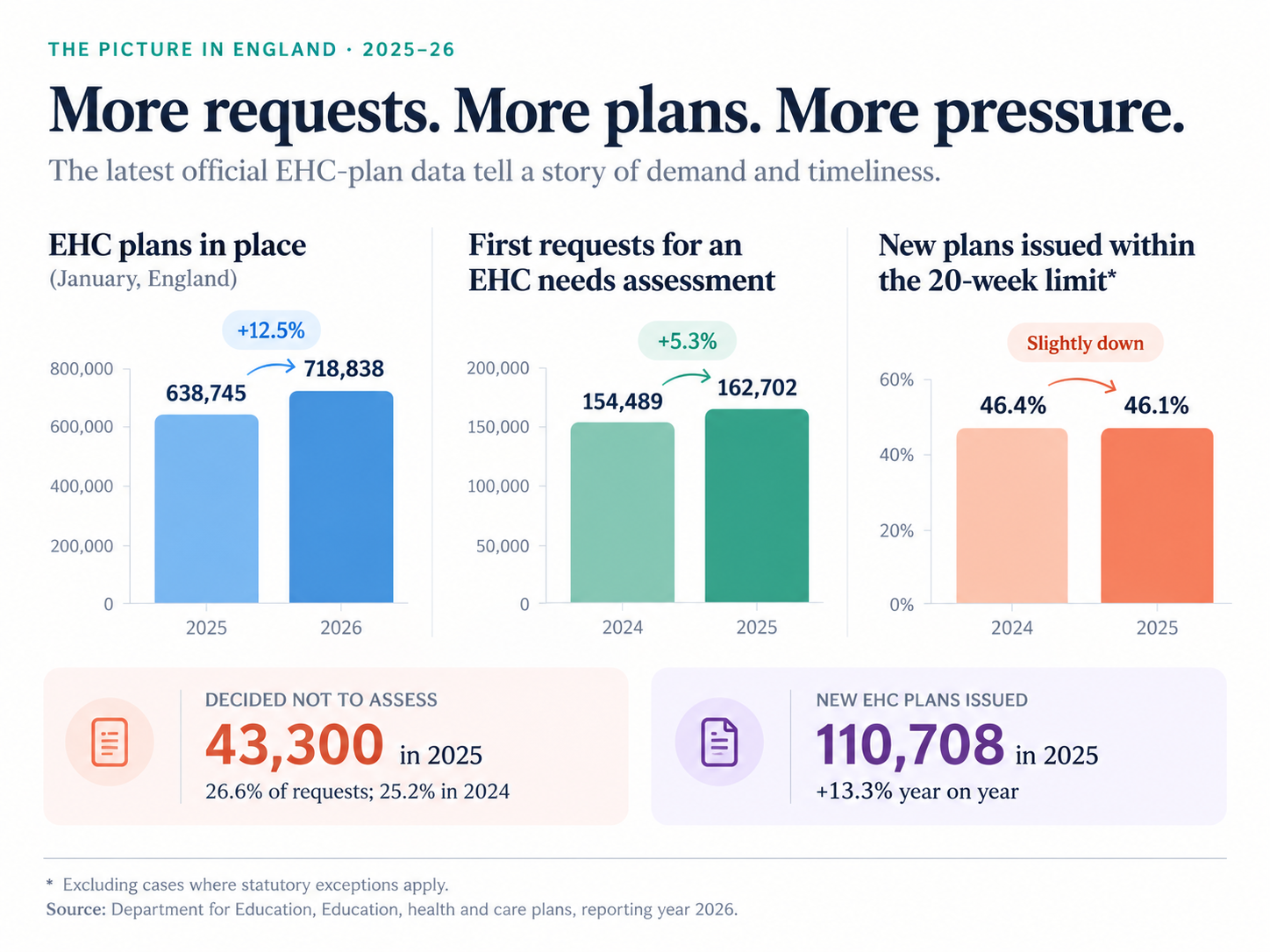
In January 2026, 718,838 children and young people in England had an education, health and care (EHC) plan, 12.5% more than a year earlier. Local authorities received 162,702 requests for an EHC needs assessment during 2025. They issued only 46.1% of new plans within the statutory 20 weeks, excluding cases covered by permitted exceptions.
Each request concerns a child whose needs can look different in the classroom, at home and in a clinic. A teacher sees one part, a parent another, a clinician a third. A local authority deciding from one of those vantage points misses what the others can see. It makes a safer decision with the whole picture in front of it and a named person owning the final judgement.
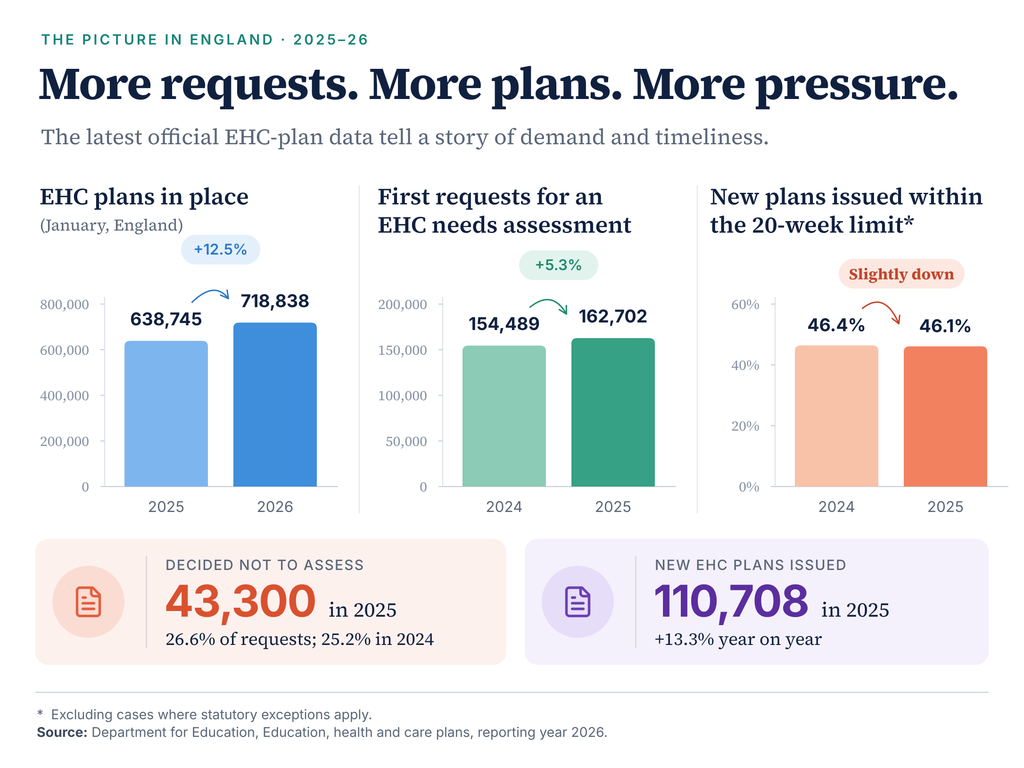
Figure 1. England’s EHC picture, 2025 to 2026. The measures cover different reporting periods and populations. Source: Department for Education, Education, health and care plans (2026).
Councils decided not to assess in 43,300 cases in 2025, 26.6% of the requests received that year, up from 25.2% in 2024. The same councils issued 110,708 new EHC plans, 13.3% more than in 2024. Each figure counts a different activity, and neither follows from the other.
Families also challenge these decisions. The First-tier Tribunal (Special Educational Needs and Disability) registered 25,000 appeals in the 2024/25 academic year, 18% more than the year before. The tribunal recorded 99% of the appeals it decided as in favour of the appellant, a category that covers appeals upheld in part as well as in full. That figure measures decided appeals only. Many registered appeals end before a hearing, and the 99% says nothing about the council decisions nobody appealed.
Decision processes alone do not explain rising demand and long waits. Funding and specialist capacity carry much of the weight. Set those pressures aside and a narrower test remains.
Once a family challenges a decision, the service should be able to show what evidence the decision-maker considered, what was missing and why they judged as they did.
Every account describes part of the child
A child may hold together through the school day and arrive home exhausted and distressed. The teacher reports progress in lessons, accurately. The parent describes the evenings, accurately. An educational psychologist identifies needs that neither account captures in full. The three accounts describe different parts of one experience, and each is true.
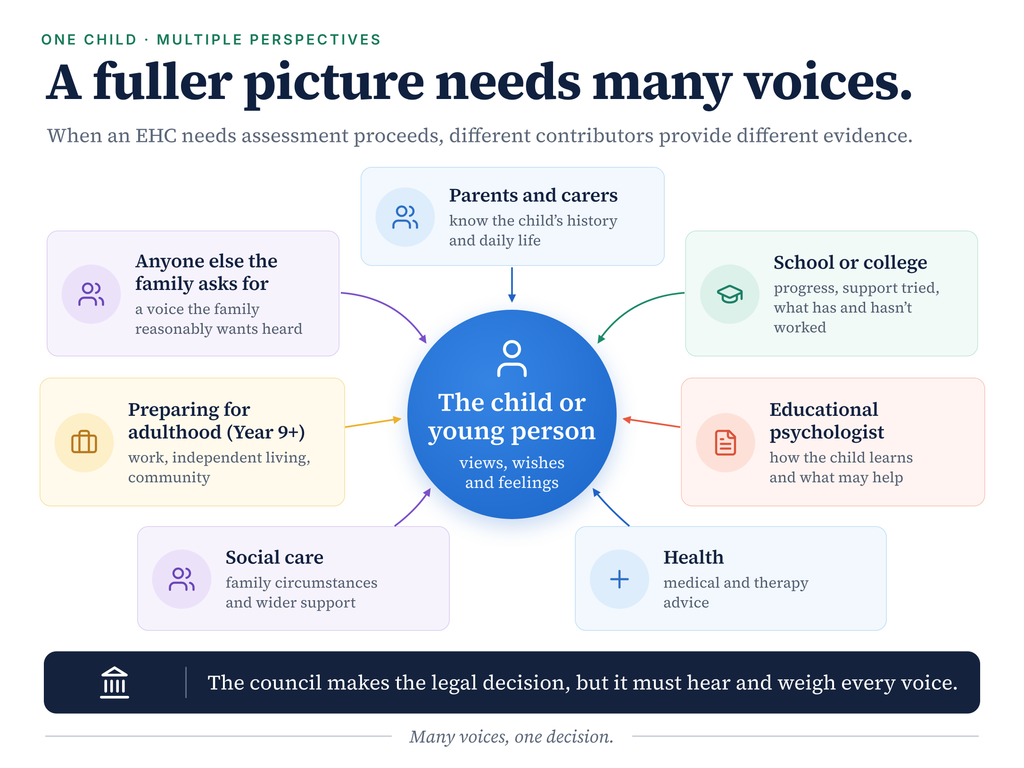
Figure 2. Several contributors feed one assessment. The child or young person stays at the centre and the local authority carries the statutory decision.
Under the Children and Families Act 2014, a parent, a young person over compulsory school age, or a person acting on behalf of a school or post-16 institution can request an EHC needs assessment. Health professionals and others can bring a child’s possible needs to the local authority’s attention. At this first stage the authority must assess where it considers that the child has, or may have, special educational needs and may need special educational provision through an EHC plan.
The authority must consult the parent or young person before it decides whether to assess, and it normally has six weeks to notify them of that decision. If it goes ahead, the law requires it to seek advice from the parent or young person and from educational, health, psychological and social care professionals. From Year 9 onwards it must also seek advice on preparing for adulthood.
Contributors share the evidence. The local authority alone owns the legal decision. Schools, clinicians and families establish the facts, and moderating groups can help keep judgements consistent and transparent, but the law still requires an individual assessment for each child and the authority signs it off.
Make the reasoning visible
A family learns nothing from a record that says only ‘approved’ or ‘refused’. A useful decision trail connects the request, the advice obtained, the legal test applied, the reasons given and the name of the accountable decision-maker. It also shows what the decision-maker knew at the time and keeps later documents out of the original record.
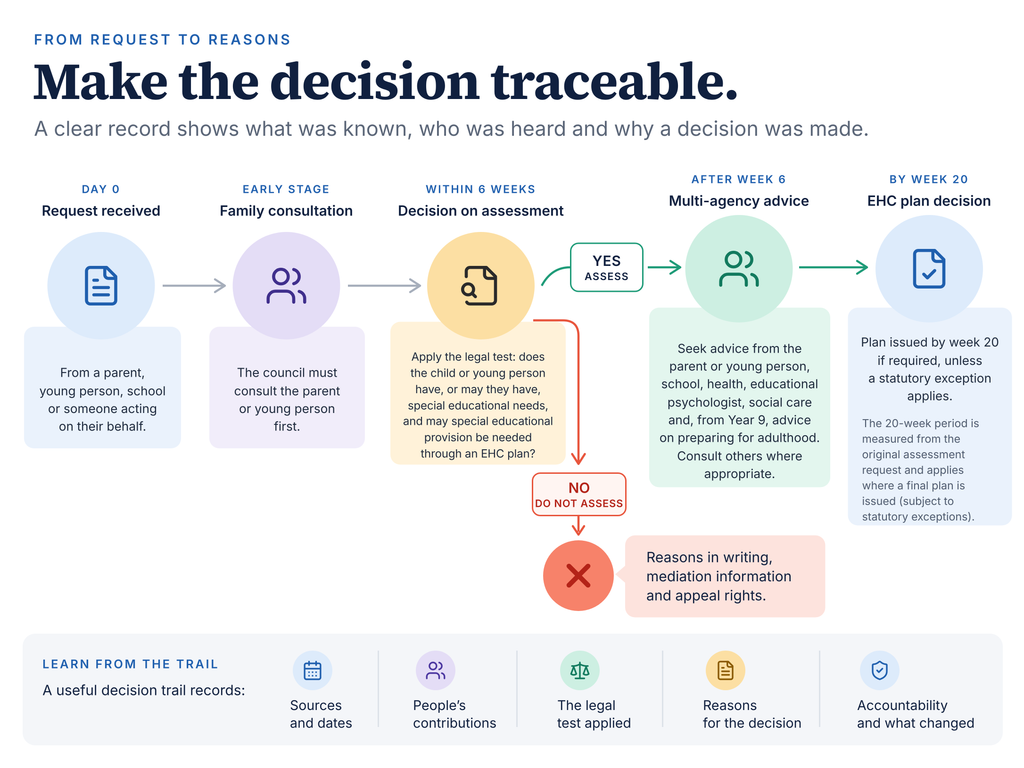
Figure 3. An illustrative decision pathway. A refusal to assess has its own notification and challenge route. Where the authority issues a plan, it is normally due within 20 weeks of the original request, subject to statutory exceptions.
The statutory pathway runs in distinct steps. The local authority normally decides whether to assess within six weeks. If it refuses, it must give reasons and tell the parent or young person about their right to mediation and appeal. If it assesses, it must then decide whether the child needs an EHC plan. Where it issues a plan, the authority counts the 20 weeks from the original request, and the decision to assess does not restart them.
A clear trail answers the practical questions a family or a reviewer will ask. It shows whether the right advice arrived, why the decision-maker preferred one report over another, whether they addressed the parent’s concerns, and what changed after a review or an appeal.
The Department for Education reports that requests received in 2025 led to around 5,100 tribunal appeals against decisions not to assess, 3.1% of all requests. A percentage explains nothing about any one dispute. A service with traceable reasons and evidence can find where its own process failed, whether in late professional advice or in an unclear letter to the family.
Hear the child directly
The child or young person is the subject of every report and the person with most at stake. The law requires the local authority to have regard to their views, wishes and feelings and to involve them in decisions about them. Hearing those views in a way that works for the individual child takes more effort than ticking a box on a form.
Rights change with age. After compulsory school age the young person holds the right to request an assessment and to take the decisions, subject to the rules on mental capacity. Parents can still support them. Any decision about a young person over that age should involve them, and the record should show that it did.
Older evidence needs the same care. A report from three years ago may no longer describe the child, and a recent snapshot may miss difficulties that have run through years of schooling and care. A fair process dates each piece of evidence, shows what has changed and marks where accounts differ, without privileging the newest document or the loudest voice.
Collaborate without sharing everything
Information about a child’s health, learning, care and family life ranks among the most sensitive a public body holds. Better collaboration means authorised contributors can work from relevant, trustworthy information while access and responsibility stay clear. Opening every record to every professional would fail the data minimisation principle and the families concerned.
Five habits make that work in practice. Share only what a stated purpose needs, behind proper access controls. Keep the source, date and context of every contribution, so a reviewer never mistakes an old report for a current assessment. Record additions and amendments without hiding what the decision-maker had in front of them at the time. Give children, young people and families real opportunities to contribute and to challenge inaccuracies, within the legal limits that apply. Make access, decisions and follow-up actions auditable while protecting confidentiality.
Data protection law and professional codes already require each of these habits. The hard part is making them routine across dozens of teams and systems working to different deadlines.
Keep the judgement with people
Digital tools can cut the time practitioners spend hunting for documents and give them more time with the case itself. An organised view of the evidence makes missing advice easy to spot, shows which reports were available on a given date and keeps statutory deadlines in view. Plain-English summaries can help people find their way through long case histories, provided the underlying records stay open and someone checks the summaries.
Professional judgement stays with the practitioner. No tool should decide in silence whether a child deserves an assessment, reduce a child’s circumstances to a score or stand in for a conversation with the family. In an area this sensitive, meaningful human involvement, the right to question a conclusion and a clear record of reasons are the safeguards that matter.
The useful test for any tool is whether the people involved can see enough reliable information to make the decision, explain it and review it responsibly.
Every decision should carry its reasons
A single report cannot capture a child’s needs, and a family should never have to reconstruct the reasoning behind a decision from letters, phone calls and disconnected records. Collaboration gives people the chance to be heard, and accountability shows them what happened to the evidence they gave.
The standard is plain. The person a decision affects should be able to understand it, a reviewer should be able to defend or overturn it on the record, and the service should be able to learn from it. These decisions will always involve judgement. A family that can read how the decision-maker reached that judgement can accept it, or challenge it, on the same evidence the council used.
Written by Seif Nasri, Research Associate at Modular Data Ltd
Sources and further reading
Department for Education, Education, health and care plans (2026; updated 17 September 2026)
Ministry of Justice, Tribunal Statistics Quarterly: July to September 2025 (SEND annual statistics)
Children and Families Act 2014, Part 3, sections 19 and 36 to 37
Special Educational Needs and Disability Regulations 2014, especially regulations 5, 6 and 13
SEND Code of Practice: 0 to 25 years
Information Commissioner’s Office, UK data protection principles