Community offender monitoring needs explainable risk signals.
Any expansion of police monitoring for people supervised in the community needs explainable, operationally useful risk signals. A police officer shouldn’t receive risk labels without seeing what has changed and why, and who authorised it.
The NPCC’s Policing Problem Book asks how forces can efficiently assess and monitor a growing number of community-based offenders, especially those at high risk. Most solutions will focus on adding more data. The Problem Book focuses particularly on registered sex offenders and home visits, but the underlying information problem also affects MAPPA management, electronic-monitoring responses and other encounters with people under community supervision.
The number of people under supervision is rising because sentencing now keeps more punishment in the community. On 31 March 2026, the prison population was 87,342, with almost no extra space available. Since 2020, the electronic monitoring caseload has more than doubled, from about 10,000 people to 26,600 by September 2025, and the Ministry of Justice expects up to 22,000 more people. In February, the Public Accounts Committee reported that the supervising workforce has not kept up, with probation officers working at 118% of capacity on average from January 2022 to April 2024, and at 126% in London and the East of England. In 2024, probation staff adequately assessed risk of harm in 28% of cases, down from 60% in 2018-19. Charges for serious further offences committed on probation rose by 55% in 2023-24 compared with 2021-22.
Police and probation already share selected information through MAPPA and ViSOR. The full risk assessment remains within HMPPS, while MAPPA arrangements share relevant assessments and management plans. Inspection evidence shows that access and sharing remain inconsistent between areas. Officers can therefore receive too little information, receive it too late, or receive a classification without enough context to judge what it means.
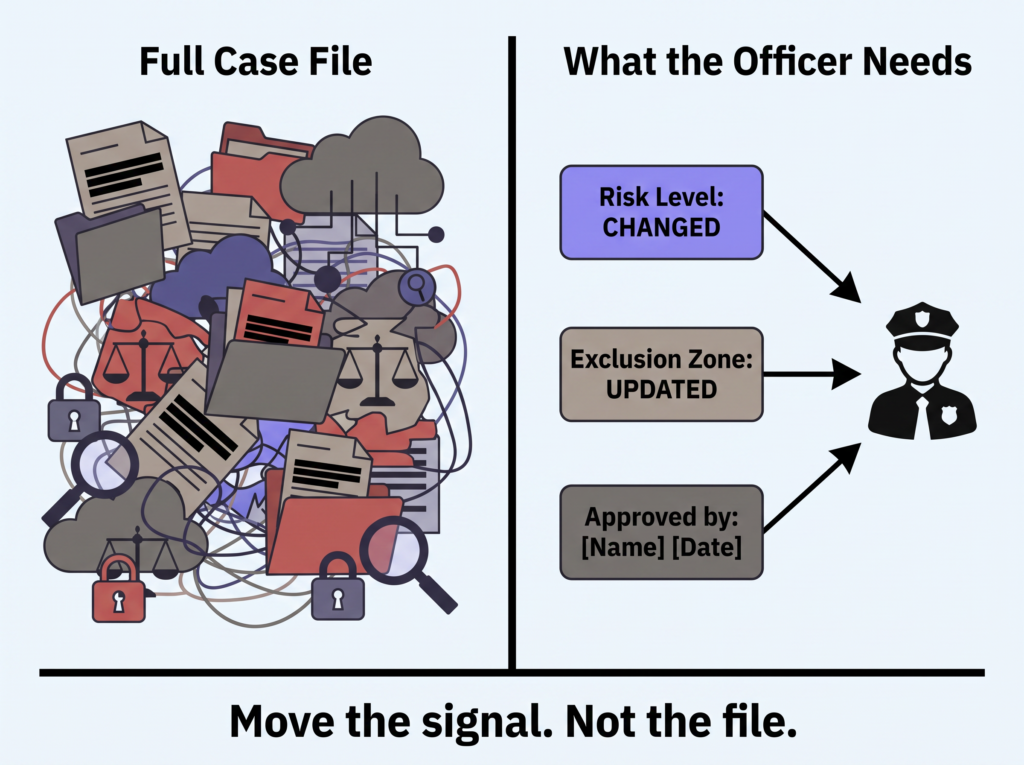
On the face of it, the quickest solution appears to be sharing full case records between agencies. There are strict governance rules around data sharing at international, national, and government department levels, and for sound reasons. In this case, a full risk assessment contains confidential details about victims, family members, and others, most of it irrelevant to the officer’s monitoring decision. Giving an officer the whole record would unnecessarily expose sensitive data. Bulk sharing has also drawn civil liberties challenges in every major police data programme of the past decade.
Most monitoring decisions are based on one or two facts, such as a recent risk classification change or a licence exclusion zone covering the officer’s current address. These signals can move between agencies without the full case file.
An officer acting on a risk classification should also see which assessment produced it and who approved it, because officers answer for their actions to supervisors and sometimes to a court. Where a law-enforcement decision is made solely through automated processing and has an adverse legal or similarly significant effect, Part 3 of the Data Protection Act 2018 requires safeguards including notification, human intervention and a route to challenge. The same design discipline should apply wherever an automated risk signal may lead to intrusive police action.
As AI begins to support triage, evidence review, and case summarisation, every recommendation should include the model and version used, the information considered, the output produced, the human review, and the final decision. An audit layer should record the state of the case before and after every decision. An untraceable classification should never reach an officer’s screen, however accurate the model behind it.
Police and probation can fix this by agreeing on the small set of important signals for community monitoring. Each signal arrives with the assessment behind it, the evidence used, and the approver’s name. Every decision taken on a signal goes into a shared audit record. None of this needs new law, and the technology exists today on open standards.
This is the kind of problem we solve at Modular Data. We built SUNRAI, our open intelligence platform, so that every fact records its source and every decision records who made it and whether they accepted or overruled the result. We have also tested AI support on the supervision side, in a proof of concept helping people on licence meet their conditions and reduce their reoffending risk. Technology can enable explainability and improve efficiency, but the solution belongs to the agencies, in their agreed signals and accountable decisions.
The Problem Book asks industry for efficiency. Forces should ask for explainability first, because officers will end up defending these decisions in court and in public.
Sources: NPCC Policing Problem Book (October 2025); Public Accounts Committee, Efficiency and resilience of the Probation Service (February 2026); MoJ, Justice in Numbers (July 2026); MoJ, Electronic Monitoring Statistics (March 2026); HMICFRS, The policing response to the investigation of online child sexual abuse and the management of registered sex offenders (April 2026).